The Hull MA is sold as the moving average that ‘removes lag’ — it reacts to price almost instantly. The pitch is that a faster MA means earlier, better trades. We tested the standard HMA(25) slope-flip through the 7-Gate Protocol to see whether less lag actually helps. Verdict: reject.
Methodology
- Data: Binance spot, Jul 2024–Jul 2026 (2 years), BTC/ETH/SOL/BNB/XRP
- Timeframes: 5m–1D (9 buckets, incl. resampled)
- Execution: The Hull MA (HMA) is a weighted-MA construction that hugs price with minimal lag. Long when the HMA turns up, short when it turns down. Closed-bar, no look-ahead
- Friction: 0.06%/side (real); 0-fee gross reported too. Benchmark: buy & hold
- Six axes: timeframe, hma length, TP:SL, multi-coin, yearly, out-of-sample
Gate 0 — Fidelity
The Hull MA (HMA) is a weighted-MA construction that hugs price with minimal lag. Long when the HMA turns up, short when it turns down. Reproduced exactly (pass).
How It Behaves
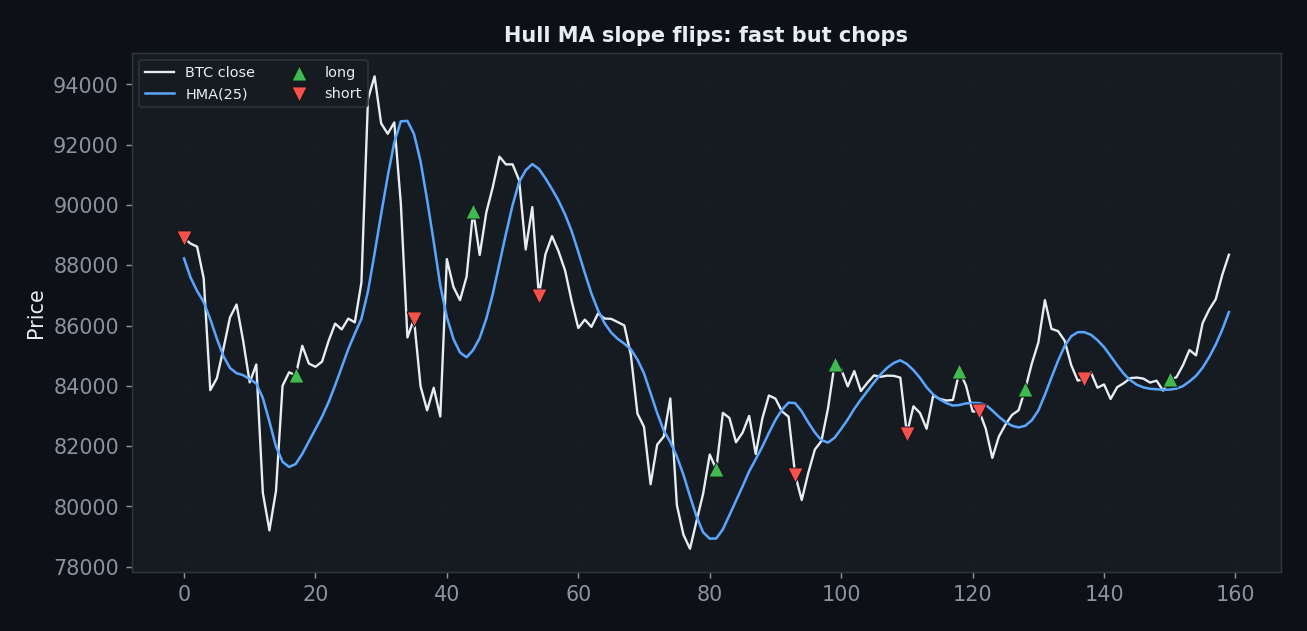
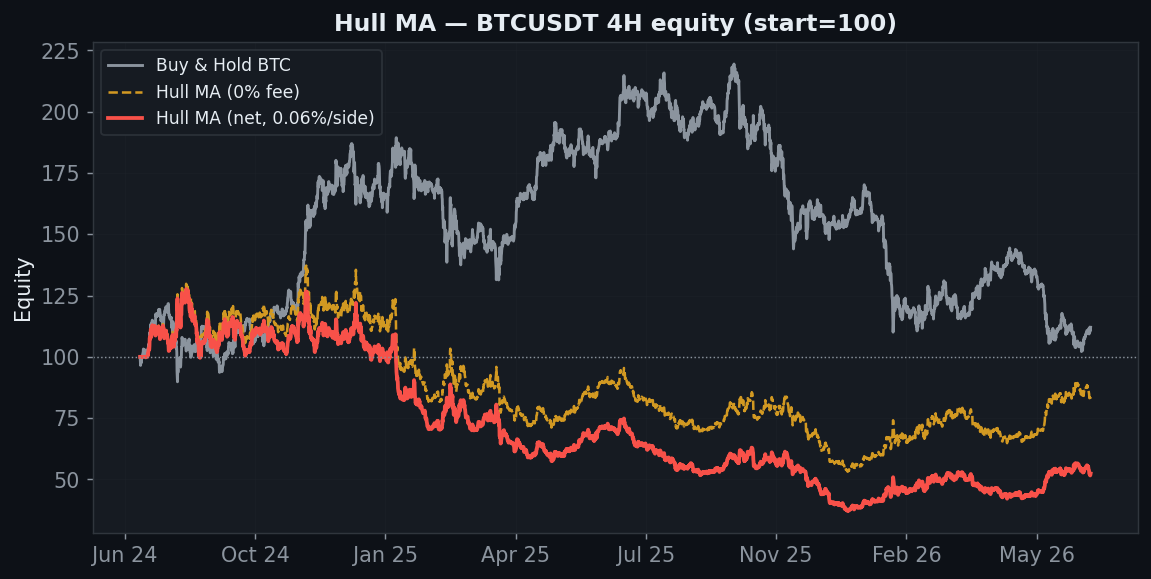
Less lag cuts both ways. The HMA turns on every minor wiggle, so in anything but a strong trend it flips constantly — buying tops and selling bottoms of noise. The result is 388 trades on the 4H and a slow, steady bleed even before fees.
Axis 1 — Timeframe
| Timeframe | Trades | Gross (0 fee) | Net (real) |
|---|---|---|---|
| 5분 | 19,329 | −36% | −100% |
| 15분 | 6,560 | −47% | −100% |
| 30분 | 3,266 | −56% | −99% |
| 1시간 | 1,584 | −14% | −87% |
| 2시간 | 819 | −12% | −67% |
| 4시간 | 388 | −16% | −48% |
| 6시간 | 266 | +20% | −13% |
| 12시간 | 135 | −30% | −41% |
| 1일 | 59 | −5% | −12% |
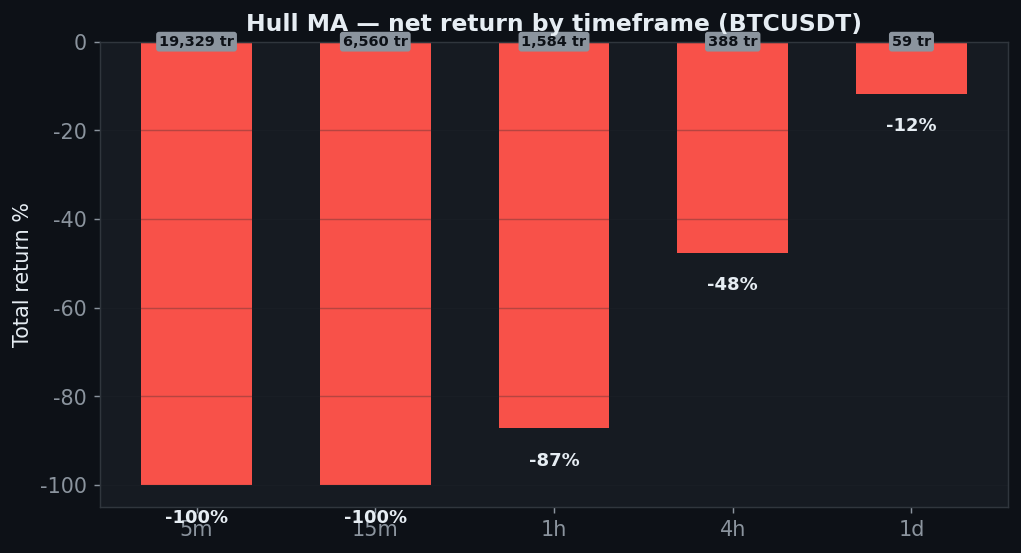
Not a single timeframe is positive on BTC. The 4H loses 48% (and −17% even at zero fees), so this isn’t a fee problem — the raw signal loses. The lag-free MA is a whipsaw machine.
Axis 2 — HMA length
| HMA length | Net | PF |
|---|---|---|
| 16 | −54% | 1.01 |
| 25 | −48% | 1.00 |
| 36 | +21% | 1.23 |
| 55 | −22% | 1.05 |
| 81 | −55% | 0.82 |
| 100 | −19% | 1.03 |
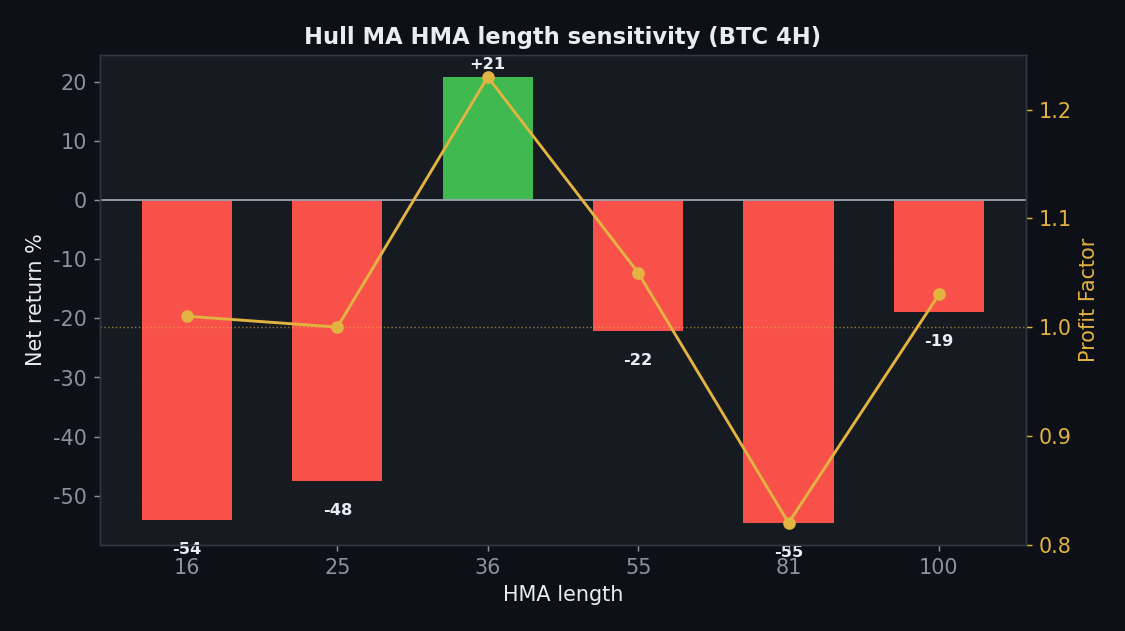
Only one length (36) is positive out of six, and its neighbours (25, 55) both lose. That lone island is curve-fit noise, not a robust setting.
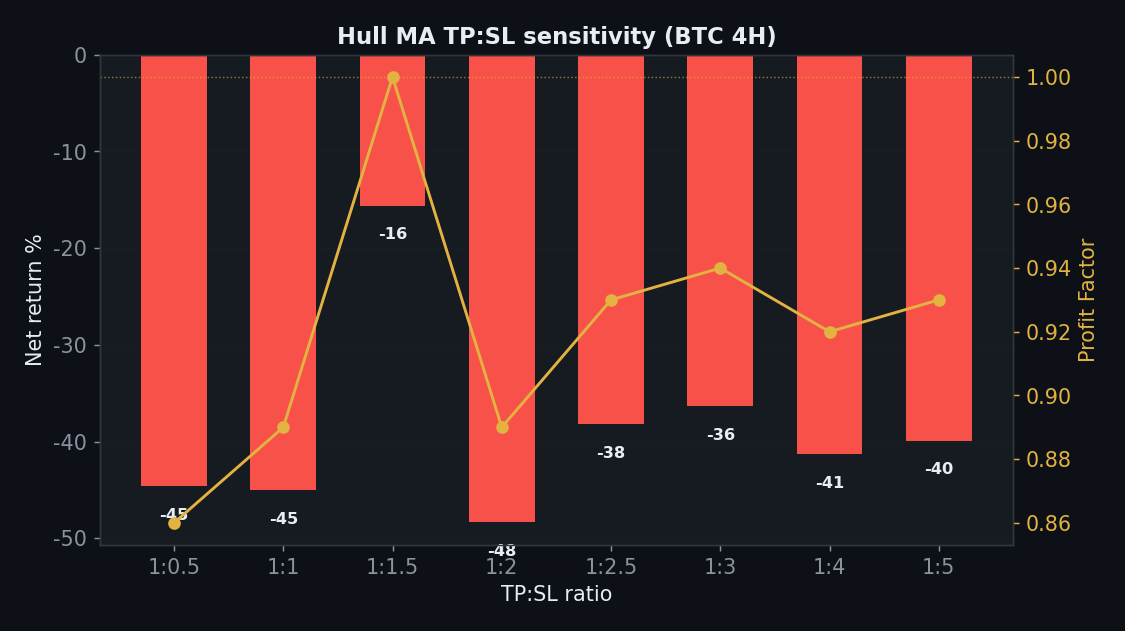
Axis 3 — TP:SL
| TP:SL | Net | PF |
|---|---|---|
| 1:0.5 | −45% | 0.86 |
| 1:1 | −45% | 0.89 |
| 1:1.5 | −16% | 1.00 |
| 1:2 | −48% | 0.89 |
| 1:2.5 | −38% | 0.93 |
| 1:3 | −36% | 0.94 |
| 1:4 | −41% | 0.92 |
| 1:5 | −40% | 0.93 |
Damning: every one of the eight TP:SL ratios loses. There is no gross edge for any exit scheme to protect — the entries themselves are the problem.
Axis 4 — Five Coins
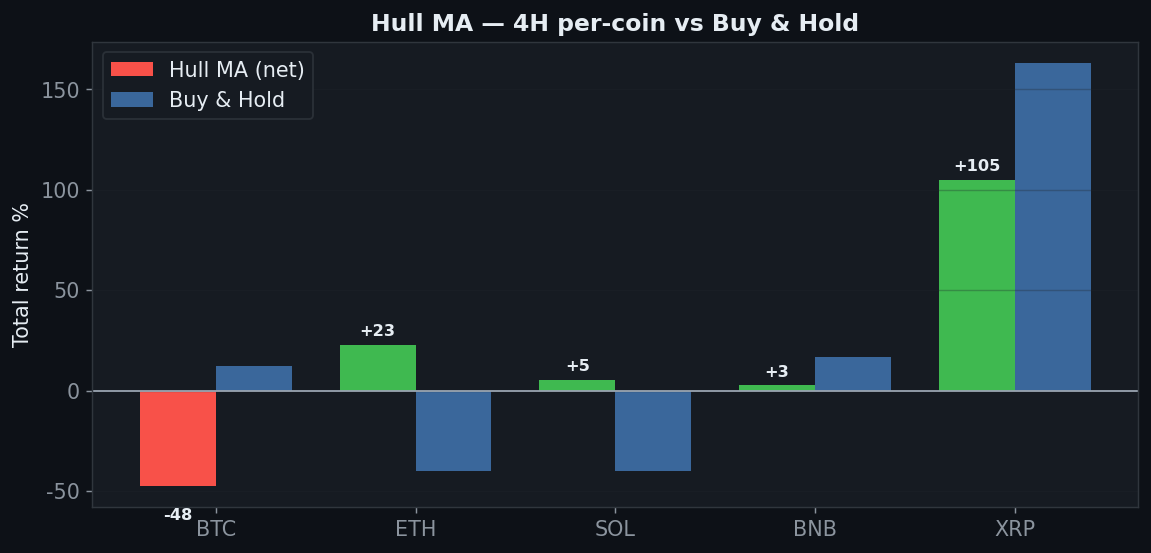
| Coin | Strategy net | Buy & Hold |
|---|---|---|
| BTC | −48% | +12% |
| ETH | +23% | −40% |
| SOL | +5% | −40% |
| BNB | +3% | +17% |
| XRP | +105% | +163% |
A misleading 4 of 5 coins are ‘positive’, but BTC — the deepest, most liquid market — loses 48%, and the alt gains are small next to XRP’s missed +163% (HMA got +105%). The core market rejects it.
Axis 5 — Yearly
| Year | BTC 4H net |
|---|---|
| 2024 | −1% |
| 2025 | −62% |
| 2026 | +39% |
2024 roughly flat (−1%), 2025 a disaster (−62%), 2026 a partial bounce (+39%). Wildly regime-dependent with a catastrophic drawdown year.
Axis 6 — Friction
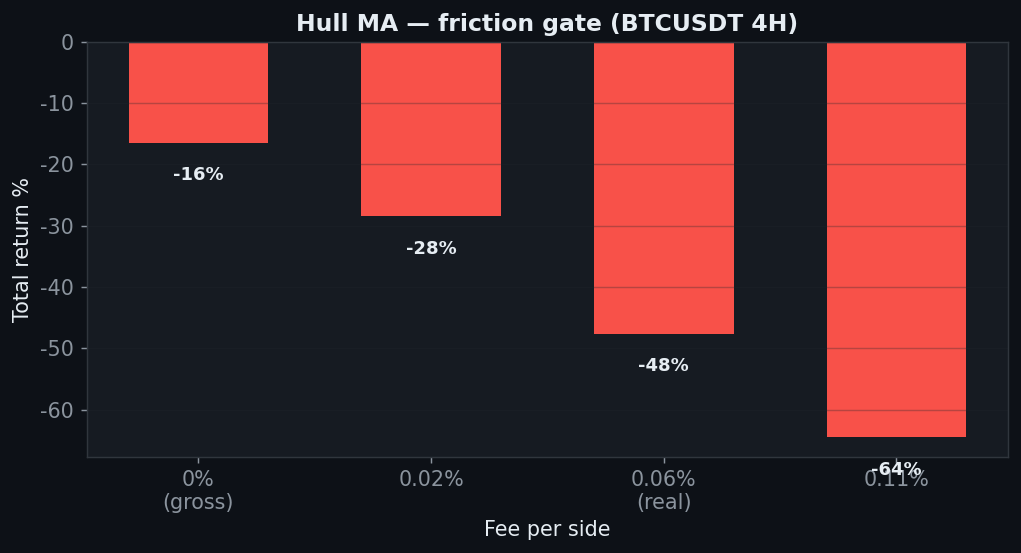
Friction only twists the knife: −17% gross → −48% net → −65% at 0.11%. 388 trades of whipsaw guarantee costs pile up on top of a losing signal.
The Verdict: REJECT
- Gate 0 — Indicator fidelity — pass (standard HMA(25))
- Gate 1 — Sanity — pass
- Gate 2 — Friction — fail — −17% gross, −48% net on 4H
- Gate 3 — Yearly — fail — −1 / −62 / +39
- Gate 4 — Robustness (length) — fail — only 1 of 6 lengths positive
- Gate 5 — Robustness (TP:SL) — fail — 0 of 8 positive
- Gate 6 — Multi-market — fail — loses 48% on BTC, the core market
- Gate 7 — vs Buy & Hold — fail — negative on every timeframe
The Hull MA delivers exactly what less lag buys you: more, earlier, worse trades. It loses on BTC at every timeframe — negative even before fees — every TP:SL ratio loses, and 2025 handed back 62%. Speed without confirmation is just whipsaw. As a standalone slope-flip, the lag-free MA is a reject.
FAQ
Isn’t the HMA better than a regular MA?
It’s smoother and faster to the eye, yes. But ‘faster to react’ also means ‘faster to be fooled’ — in ranges it flips on noise. Our test shows the speed doesn’t translate into profit; if anything it worsens the whipsaw.
What about using HMA as a trend filter, not an entry?
As a higher-timeframe direction filter feeding a different entry it might help — that’s a separate system. The standalone slope-flip taught in most videos is what we measured, and it fails.
Can I replicate this?
Yes — HMA(25) slope-flip, public Binance data, 0.06%/side, five coins, nine timeframes. Every table reproduces.
See also the rejects Keltner and Donchian, and the conditional passes Vortex and Ichimoku (daily).
Disclaimer: educational research, not financial advice. Past performance does not guarantee future results. Never trade money you cannot afford to lose.
Leave a Reply