The “Range Filter Buy and Sell 5min” is one of the most forked, most screen-recorded indicators on TradingView. A single smooth line that turns green and prints “BUY”, turns red and prints “SELL” — and a thousand videos titled “this 5-minute strategy prints money.” Under the hood it is simply another ATR-style trailing filter, a close cousin of two strategies we’ve already buried: UT Bot and Triple SuperTrend. We ran guikroth’s version through the full 7-Gate Protocol. Same family, same verdict: reject.
Gate 00 — Fidelity
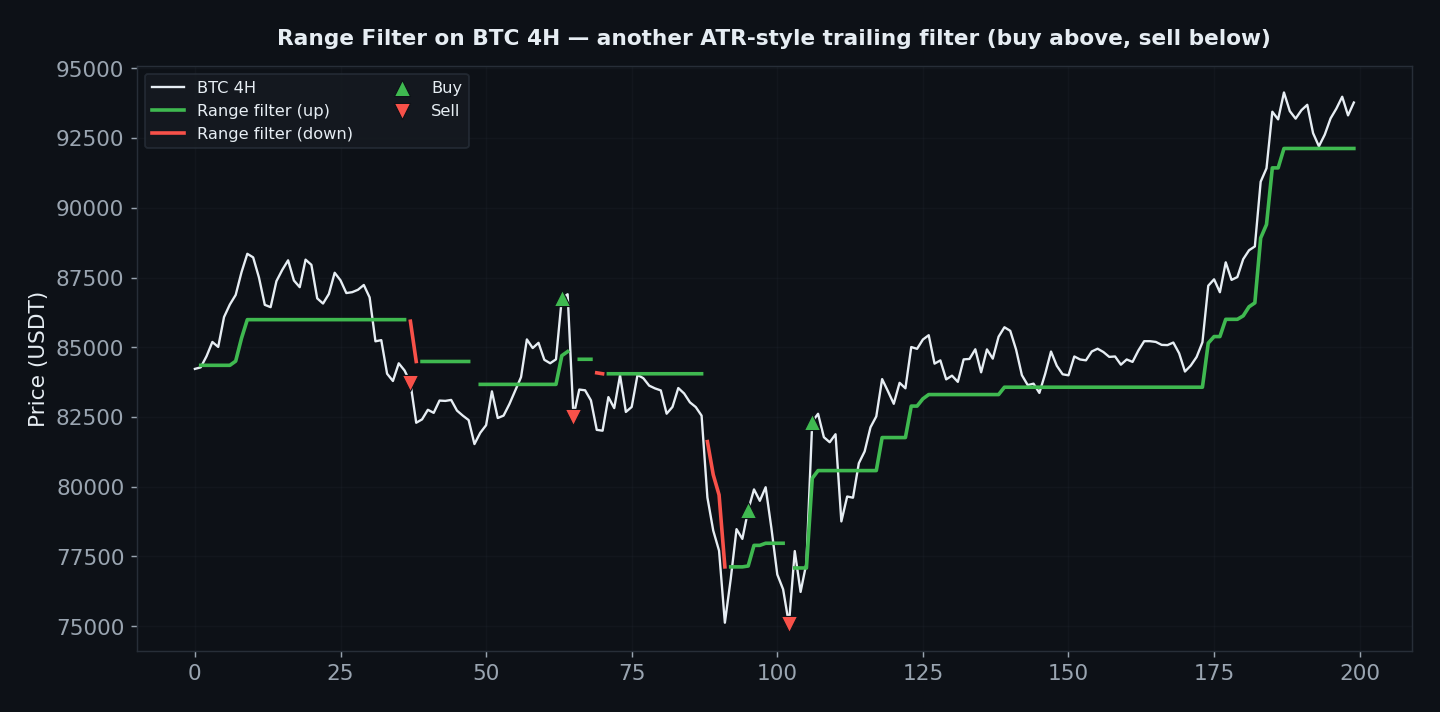
We reproduced guikroth’s public Pine exactly: an EMA of the absolute bar-to-bar price change, smoothed again and multiplied by the range multiplier (defaults: sampling period 100, multiplier 3.0). The filter trails price and flips color; you go long above it, short below. Nothing exotic — and nothing to get wrong.
The Exact Rules
- Signal: price closes above the (rising) range filter → long; closes below the (falling) filter → short. Stop-and-reverse (always in the market)
- Settings: sampling period 100, multiplier 3.0 (the shared default)
- Execution: on the bar close, no look-ahead; costs 0.06%/side; data Binance spot Jul 2024–Jul 2026, BTC/ETH/SOL/BNB/XRP, 5m–1D; benchmark buy & hold
It’s a “5-minute” filter that returns −100% on 5 minutes
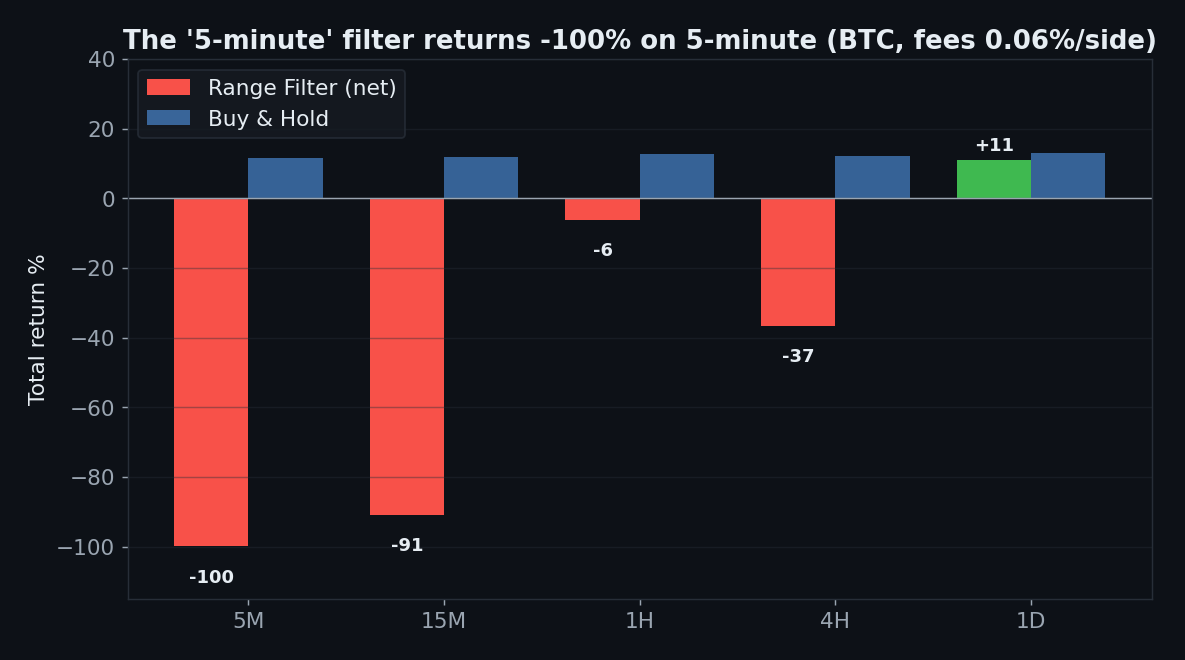
The indicator is literally named for the 5-minute chart. On the 5-minute chart it takes 6,465 trades and returns −100% — the account is gone. 15m: −91%. 4h: −37%. It loses to buy & hold on all five timeframes, and the “best” one (daily +11%) still trails simply holding. The trailing-filter family self-destructs on the fast charts it’s marketed on, exactly like UT Bot and SuperTrend before it.
Gate 04 — Out-of-Sample (the tell)
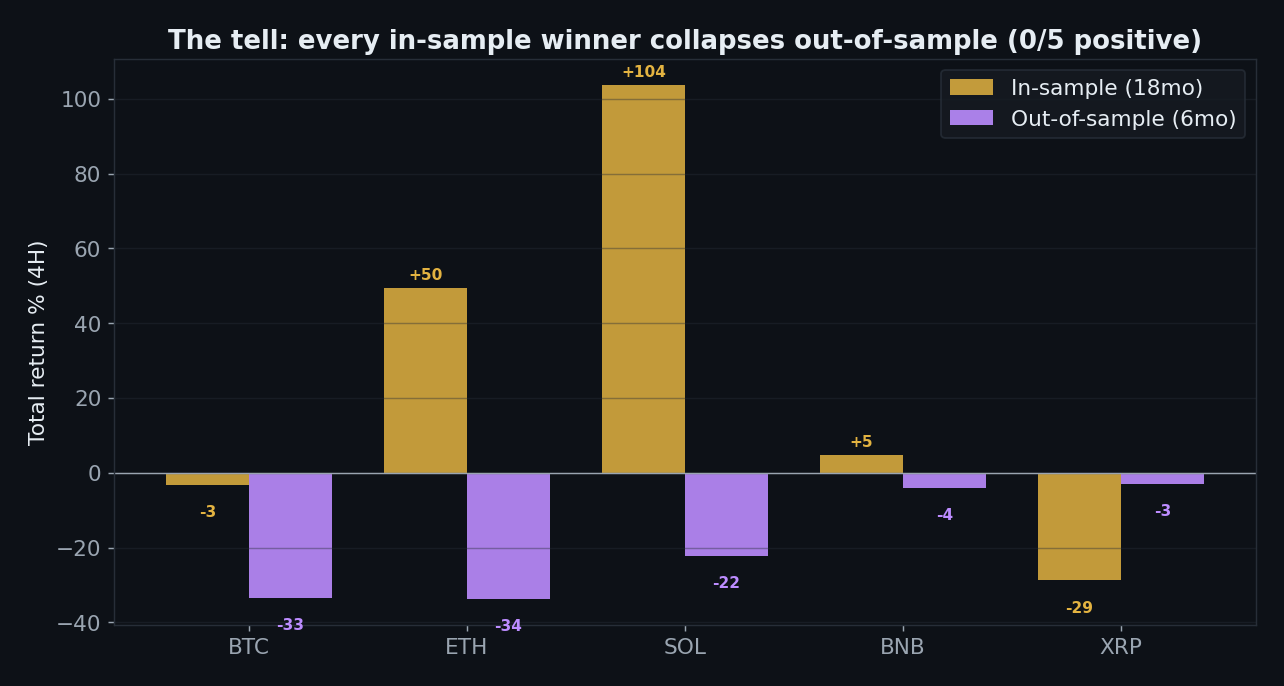
This is the cleanest kill we’ve filmed. Split each coin 18 months in / 6 months out. In-sample, a couple of coins look brilliant — SOL +104%, ETH +50%. Out-of-sample, every single one turns negative (SOL −22%, ETH −34%, BNB −4%): 0 of 5 positive out-of-sample. When your winners exist only in the half of the data you fit to, you didn’t find an edge — you found the past.
Gate 06 — Five Coins & Gate 02 — Friction
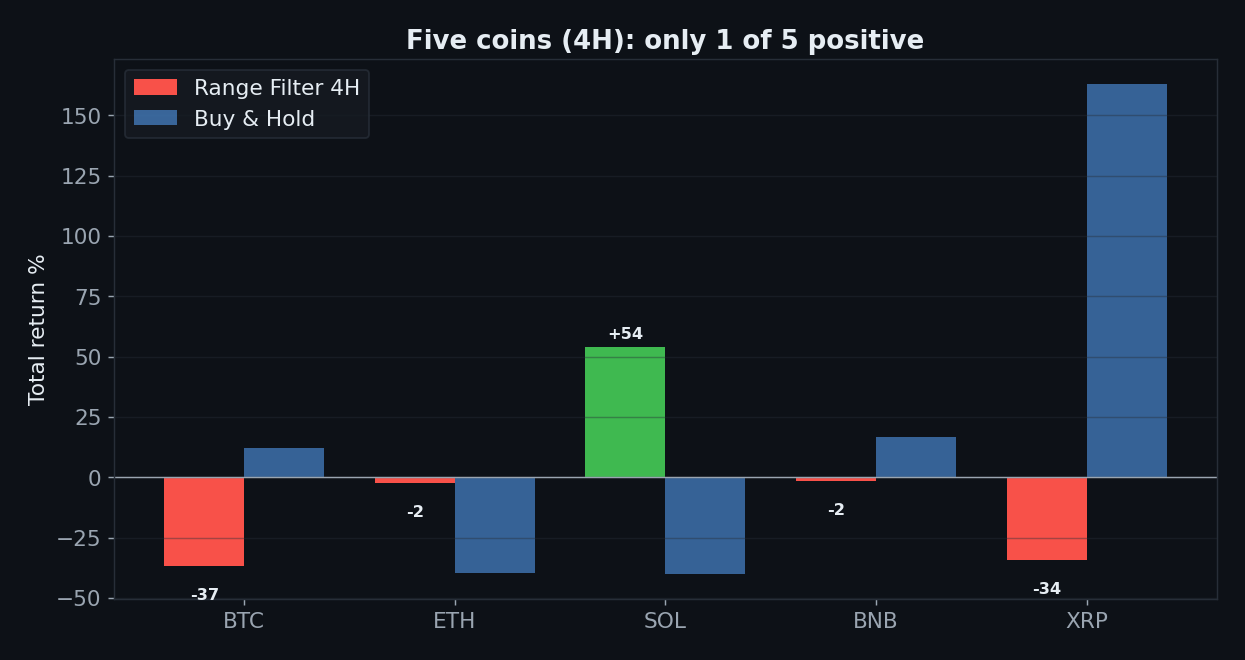
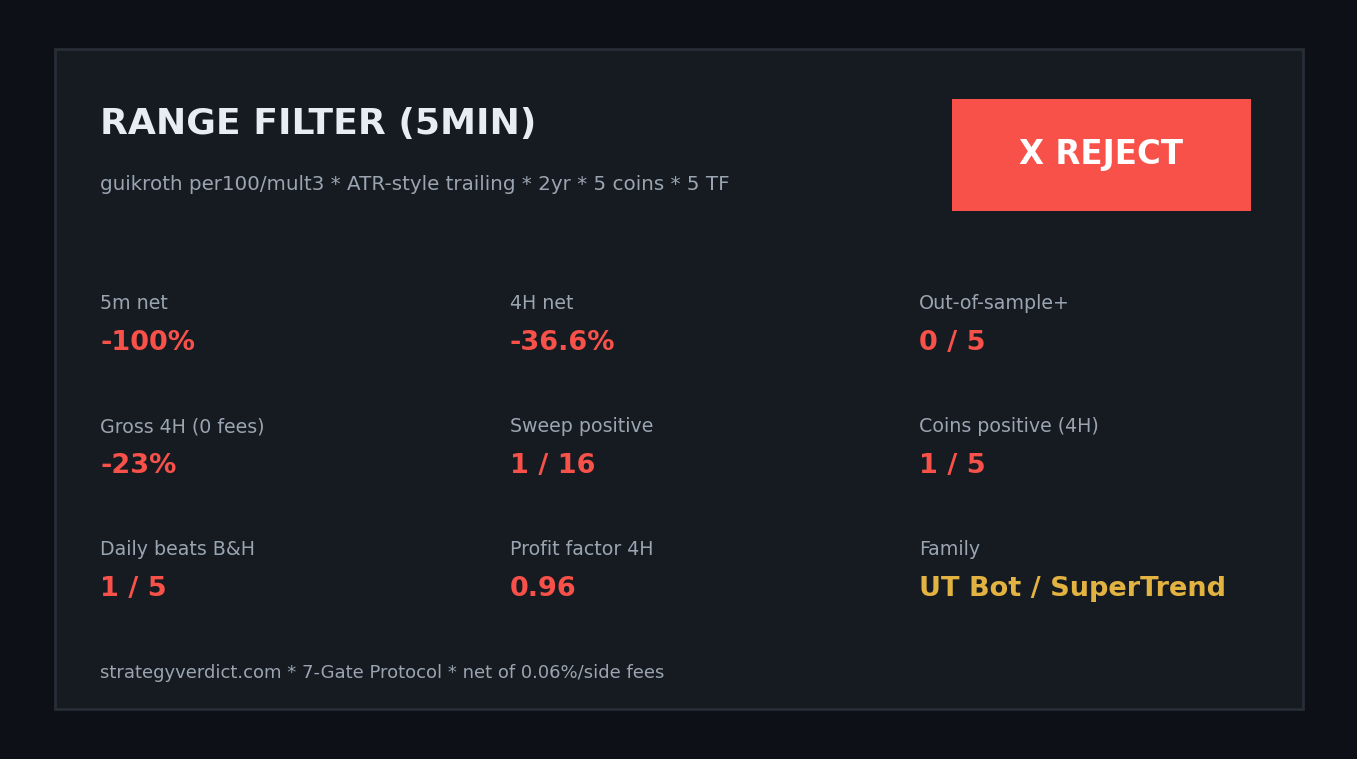
On 4H only 1 of 5 coins is profitable (SOL, the same coin that then dies out-of-sample). And the friction test shows there was never a gross edge to erode:
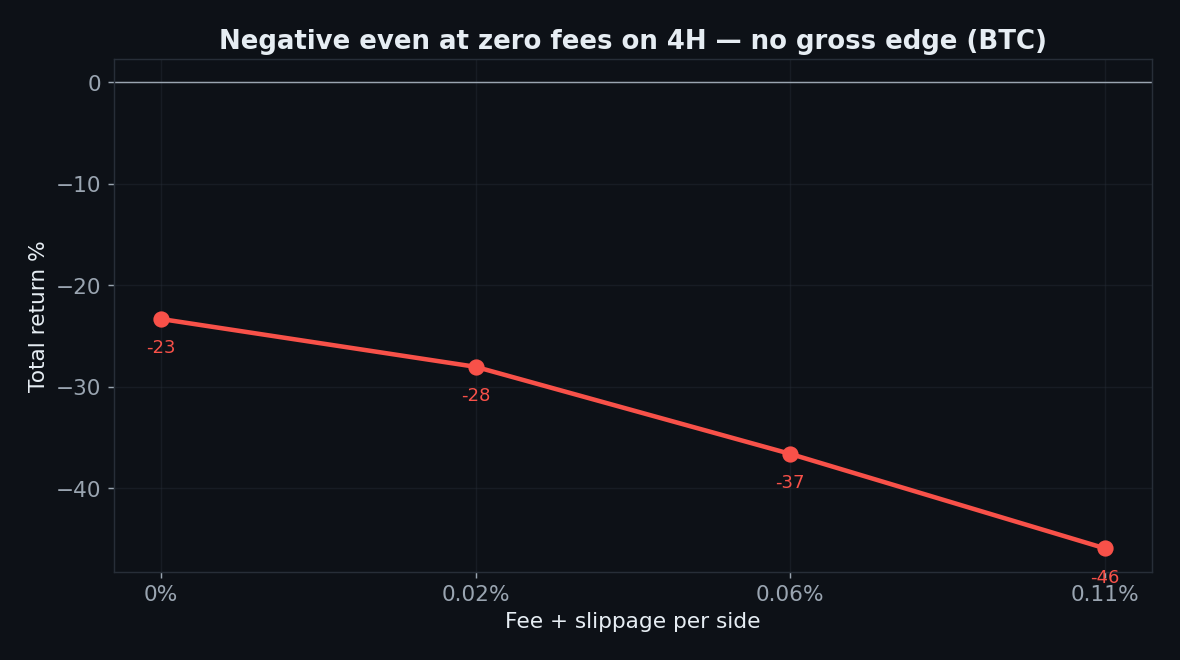
−23% on BTC 4H at zero fees. The parameter sweep is just as bleak: only 1 of 16 period/multiplier combinations is positive.
The Verdict: REJECT
- Gate 0 — Indicator fidelity — pass (faithful reproduction of guikroth’s public Range Filter, period 100 / multiplier 3)
- Gate 1 — Sanity — pass (signal on the closed bar, no look-ahead)
- Gate 2 — Friction — fail (negative even at zero fees on 4H; 5m → −100%)
- Gate 3 — Yearly consistency — fail (no consistently positive year)
- Gate 4 — Out-of-sample — fail hard (0 of 5 coins positive out-of-sample — SOL +104% in-sample → −22% out)
- Gate 5 — Robustness — fail (only 1 of 16 period × multiplier cells positive)
- Gate 6 — Multi-market — fail (1 of 5 coins positive on 4H)
- Gate 7 — vs Buy & Hold — fail (behind on every timeframe)
Range Filter is the third ATR-style trailing indicator we’ve tested, and the third to fail the same way. UT Bot, Triple SuperTrend, and now Range Filter all promise “5-minute” signals and all return roughly −100% on the 5-minute chart once you pay fees. The lesson isn’t about any one indicator — it’s that a smoothed trailing stop is not a strategy, and repackaging it with new colours and a new name doesn’t change the maths. Range Filter also fails the one test the others occasionally survived: out-of-sample, it’s 0 for 5.
FAQ
Isn’t this different from UT Bot?
Cosmetically. The smoothing differs (EMA-of-absolute-change vs ATR), but both are trailing filters that flip long/short on a crossing. They share the same failure mode: constant flipping on fast charts, fees bigger than the edge.
The in-sample SOL result was +104% though.
And it went to −22% out-of-sample. That’s the entire point of an out-of-sample test: in-sample numbers are the strategy describing the data it was fit on. Only the out-of-sample number is a prediction, and here it’s negative on all five coins.
Can I replicate this?
Yes — guikroth’s public Range Filter (period 100, mult 3), Binance data, 0.06%/side.
See also the rest of the trailing-filter family: UT Bot, Triple SuperTrend; and our one conditional pass among trend systems, Ichimoku cloud breakout.
Disclaimer: educational research, not financial advice. Past performance does not guarantee future results. Never trade money you cannot afford to lose.
Leave a Reply